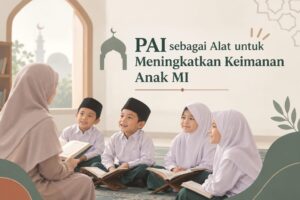
ISLAMIC RELIGIOUS EDUCATION AS A SUBJECT FOR SHAPING THE
GENERATION OF BELIEVERS AT MADRASAH IBTIDAIYAH
Oleh: Olyska Abdur Rohman
Introduction
Madrasah Ibtidaiyah is the most basic level in madrasah education. At this age, children begin
to know what is good and what is bad. Children begin to learn to apply attitudes that will be the
foundation of their lives later (Salsabila et al., 2024). Therefore, the subject of Islamic religious
education cannot be considered trivial. Because this subject is the beginning of the foundation of a
child’s life built through noble attitudes.
However, in reality, there are many moral deviations in the middle of society that indirectly
affect the values that have been instilled in children (Aulia et al., 2026). Not only the influence of the
real environment. A lot of information or content is not in line with religious teachings and spreads
through social media. This makes the noble foundation that has been instilled very worrisome.
Therefore, a strategy is needed in forming a generation of believers through this Islamic Religious
Education subject.
The Meaning of the Generation of Believers in PAI Learning
In PAI subjects, the generation of believers is not the one who memorizes the most. However,
it can be called a generation of faith if he is able to internalize the values that have been taught in
class into real life. Because young children tend to imitate what they see, as a teacher, in addition to
instilling noble values, teachers must also set an example for their students.
Wakidi and Musnandar (2022) formulated PAI as a conscious, planned, and systematic effort
to prepare students to believe, understand, live, and practice Islamic teachings through guidance,
teaching, and practice. The formula shows three layers of achievement: knowing, willing, and being
able to do. Children can know noble attitudes when teaching in the classroom. Because children
already know that being noble is something good, children will have the desire to apply it. When a
strong desire has arisen, children will have an inner urge to do good. Then it will continue to repeat
until it is embedded in the child’s heart.
Values Instilled in Madrasah Ibtidaiyah
Research at MI Ma’arif Polorejo, Ponorogo, found four values of worship instilled in students,
namely piety, discipline, patience, and honesty (Astuti, 2022). The value of discipline is seen in the
obligation to pray Dhuhur in congregation at the madrasah mosque and the Dhuha sunnah prayer
guided by teachers. The value of honesty is trained through supervision during exams and filling out
Ramadan activity books. The value of patience is instilled through an approach from the example of
the Prophet Job.
The broader picture is shown by Wakidi and Musnandar (2022). According to them, the value
of PAI revolves around three aspects: worship, muamalah, and morals. Although the research was
conducted at the junior high school level, this finding can be used as a comparison because the pattern
of habituation is the same: greetings and greetings in the morning, prayers at the beginning and end
of lessons, Dhuha and Dhuhur prayers in congregation, infak every Friday, and visiting sick friends.
Every activity carried out carries a meaningful message. Shaking hands with teachers fosters respect
and emotional closeness, congregational prayers practice discipline and togetherness, while infak
fosters a sense of generosity and social concern.
At the MI level, these values are also in line with the Love-Based Curriculum which places
compassion and empathy as the foundation of learning. This curriculum rests on five points: love for
God and the Messenger, love of science, love of the environment, love of fellow humans, and love of
the homeland. In this learning, faith is not only ritual obedience, but also compassion that is seen in
relationships with others and the environment.
PAI Teachers as Role Models and Value Planters
In the process of forming a generation of believers, PAI teachers play a central role. PAI
teachers are not only transfer of knowledge, but also internalize good values in students. Broad
religious knowledge will be useless if it is not accompanied by good qualities, because that is what
makes teachers role models in the learning process.
As practiced at MI Ma’arif Polorejo, madrasas not only require students to pray, but teachers as
role models are also required to participate in congregational prayers. Not only that, teachers are also
required to be present in activities such as istighastah and grand recitation (Astuti, 2022). The same
thing is also applied at SMP PGRI 05 Tirtoyudo, namely teachers arrive early in neat clothes to
welcome students at the gate, so that students are more easily directed to discipline (Wakidi &
Musnandar, 2022). The principle is very simple, namely that children imitate more than listen.
As a professional PAI teacher, it is necessary to master pedagogic, personality, and social
competencies. In addition, PAI teachers must also know the individual of each student as the basis
for determining the goals, methods, and learning materials.
Habituation Strategies Inside and Outside the Classroom
The main strategies commonly used by PAI teachers are habituation, example, and discipline
coaching (Husna, 2024). Habituation means doing activities repeatedly until it becomes a habit. At
MI, habituation takes place through two paths. In the intracurricular pathway, the value of worship is
included in the curriculum through the practice of fiqh material, repeated delivery of material, and
semester exams. For example, grade 1 students answer fiqh questions in the form of pictures of prayer
movements. In the extracurricular pathway, the values of responsibility, discipline, and togetherness
are instilled through scouts, marching bands, tahfiz Al-Qur’an, and other activities accompanied by
teachers (Astuti, 2022).
This gradual pattern is in line with the principles that run continuously in the development of
character-based PAI curriculum. An example of the application of honesty values: in grades 1 and 2
it is introduced through the story of the Prophet Muhammad (saw), in grades 3 and 4 through daily
habits, in grades 5 and 6 through difficult situations, then habituation is strengthened in the next level.
In this case, a written test is not needed, because the success or failure of the learning will definitely
be reflected in daily life.
Learning Innovation to Keep PAI Relevant
PAI is often considered a formality subject only. Because the learning tends to be textual.
Therefore, learning innovations are needed that eliminate the view that PAI is just a formality.
Interactive and dynamic learning is needed. It can be through interactive videos, online quizzes, and
animations to present material that has been considered dry. Then project-based learning, for example
social service or community service that instills the value of helping and caring.
Collaboration of Teachers, Parents, and the Community
Children’s character is not formed at school alone. The family as the closest environment must
strengthen the values taught in the classroom. For example, by inviting children to worship regularly,
speak politely, and participate in social activities. Children who do not receive religious guidance
from an early age are more difficult to direct, while children who are guided by their parents tend to
be easier to obey teachers and respect their friends. In addition, children’s habits, parental support,
curriculum at school, peers, worship facilities, and living environment also determine the success of
coaching.
Challenges That Need to Be Answered
There are at least four challenges that arise from the sources above. First, family background.
Astuti (2022) noted that some students of MI Ma’arif Polorejo were left behind by their parents to
work abroad and replaced by caregivers, so that psychologically it had an impact on children’s
behavior which tends to be difficult to regulate and difficult to be polite.
Second, the coverage of values is not even. Astuti (2022) found that the cultivation of alms,
zakat, infaq, and waqf values has not stood out, even though the practice already exists through zakat
fitrah and compensation for orphans. This practice has not been managed as a planned value planting
strategy.
Third, teacher readiness and facilities. The study of the Love-Based Curriculum showed a lack
of understanding of teachers, a lack of training and modules, and limited time and supporting
facilities. A similar thing was found in the use of interactive media, namely the limitations of devices
and lack of teacher training
Fourth, the risk of formality. The principle of character-based curriculum development reminds
us that character values should not only be jargon on curriculum objectives, but should animate all
components: objectives, materials, strategies, and evaluations. At the same time, character integration
needs to be more emphasized and pay attention to the allocation of available time.
Closing
PAI at Madrasah Ibtidaiyah has an important role in shaping a generation of believers, namely
a generation that not only understands Islamic teachings, but also lives and practices them. This goal
is achieved through teacher example, consistent habituation through intracurricular and
extracurricular activities, innovative and contextual learning, and collaboration with parents and the
community. All of this needs to be supported by teacher readiness, support from the madrasah head,
and continuous character evaluation.
In the end, the generation of believers is formed not by very long memorization, but by the most
frequent experiences. Such as teachers who welcome with a smile, congregational prayers that are
done together, and an environment that shows that faith lives in daily deeds.
Bibliography
Astuti, H. K. (2022). Strategies of Islamic Religious Education teachers in instilling worship values
at Madrasah Ibtidaiyah Ma’arif Polorejo Babadan Ponorogo. Ma’alim: Journal of Islamic
Education, 3(2), 187–200.
Aulia, A., Ramadhani, N., Haq, D., & Aminullah. (2026). Development of a character-based Islamic
Religious Education (PAI) curriculum (basic concepts, principles, and strategies for its
development). QOSIM: Journal of Education, Social & Humanities, 4(5), 7093–7103.
Husna. (2024). The role of Islamic Religious Education teachers in the formation of student character:
Strategies and impacts in the school environment. Al-Ulum: Multidisciplinary Research
Review, 1(1), 54–72.
Salsabila, D., Arief, A., & Rehani. (2024). Innovation in Islamic Religious Education learning in
Elementary / MI to build children’s character from an early age. Holistic Nexus Analysis, 1(11),
39–46.
Wakidi, & Musnandar, A. (2022). The Values of Islamic Religious Education and Its Implementation
in Developing the Islamic Characteristics of Students. TAUGHT: Journal of Education and
Learning, 1(3), 303–311.