Why Does Islamophobia Still Exist?
Understanding Fear, Stereotypes, and Muslims
Oleh: Muhammad Habib An-Nizami Tanjung
Islamophobia does not always arrive as an angry speech or a violent attack. Sometimes it is much quieter. It can appear in the way a Muslim is looked at on public transport, a joke about a woman’s hijab, a question about whether Muslims can really belong to a certain country, or an assumption that a person must be dangerous because of their religion.
That is what makes the issue difficult. Fear does not always announce itself as hatred. Sometimes it grows through small assumptions that are repeated until they begin to feel normal.
The problem is still visible in many parts of the world. A 2024 report by the European Union Agency for Fundamental Rights found that around half of the Muslims surveyed across 13 European Union countries had experienced racial discrimination in the five years before the survey. Muslim women wearing religious clothing were among those particularly affected.
But understanding Islamophobia should not begin with blaming everyone who has questions about Islam. People can disagree with a religion. They can criticize religious ideas. They can ask difficult questions. The line is crossed when criticism turns into prejudice against people simply because they are Muslim.
WHEN A PERSON BECOMES A STEREOTYPE
One of the easiest ways prejudice grows is by turning millions of different people into one imagined group.
There are Muslims in Indonesia, Nigeria, Turkey, India, the United Kingdom, the United States, Egypt, Bosnia, Malaysia, and many other places. They speak different languages and come from different cultures. They do not share one political opinion or one way of practicing their faith. Some are highly religious, others are less observant. Their lives are as varied as the societies they live in.
Yet familiar stereotypes can make that diversity disappear. Muslims are sometimes described as violent, intolerant, oppressed, anti-Western, or unwilling to live with people of other religions. These ideas may come from personal experiences, political arguments, entertainment, news coverage, or things people encounter online.
A stereotype can be especially powerful when someone has little direct experience with the people being discussed. If a person rarely meets Muslims but repeatedly sees Muslims associated with terrorism or conflict, those images can become their main reference point.
That does not mean every concern about Islam is irrational, and it does not mean wrongdoing within Muslim communities should be ignored. Muslims are human beings. They can make serious mistakes, commit crimes, hold harmful beliefs, or disagree with one another. But an individual’s actions cannot fairly be used as a description of an entire religious community.
The same distinction matters when discussing extremist violence. If someone commits a crime while claiming to act in the name of Islam, the crime should be condemned. There is no need to soften that judgment. What deserves more care is the jump from “this person committed a violent act” to “this is what Muslims are like.”
Those are two very different statements.
WHY FEAR CAN BE SO DIFFICULT TO UNLEARN
Fear often survives because it is fed by repetition.
A person may encounter Islam through a news report about terrorism, a political speech about national security, a controversial social media post, and a dramatic video. None of these things necessarily represents the everyday life of an ordinary Muslim. Yet when the same associations appear again and again, they can become difficult to separate.
There is also the problem of distance. It is easier to imagine a stranger as a threat when the stranger remains a stranger.A Muslim neighbor becomes harder to reduce to a stereotype once you know that he worries about his children’s education, or that the woman wearing a hijab beside you is trying to catch the same bus to work. Personal contact does not make every disagreement disappear. It simply gives people a fuller picture.
This matters because Islamophobia is not always built from deliberate hatred. Sometimes it grows from unfamiliarity, incomplete information, or a lack of opportunities to meet people outside one’s own social circle.That is why conversation matters. Not every conversation will change someone’s mind. But without conversation, assumptions have little reason to change.
WHEN THE NEWS BECOMES THE MAIN WINDOW
The media plays a complicated role in all of this.
Journalists have to report terrorism, war, political conflict, and crime. Those events are newsworthy. The problem is what happens when Muslims appear in the public conversation mainly through those subjects.
A major review of 345 studies on media representations of Islam and Muslims found that migration, terrorism, and war were among the most common themes studied. The researchers also found that Muslims were often framed negatively and that Islam was frequently presented through associations with violence.
More recent research has found that terrorist attacks can sharply change the amount and tone of media attention given to Islam and Muslims. A 2025 study examining more than 262,000 articles from major newspapers in the United Kingdom, Germany, and France found that coverage of Islam and Muslims was heavily concentrated around major terrorist attacks. The researchers found that such events could also encourage coverage that treated Muslims and Islam as a single, uniform subject.
This does not mean journalists are secretly trying to create hatred toward Muslims. Newsrooms work under deadlines, audiences respond to dramatic events, and violence naturally receives attention. Still, repeated patterns can have consequences even when nobody intends them.
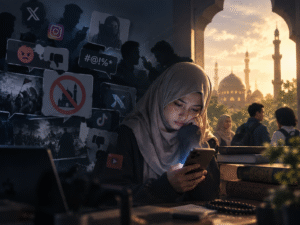
The internet adds another layer. A misleading post can travel much faster than a careful explanation. A photograph can be shared without its original context. A short clip can make someone appear to say something they never meant. Algorithms can also keep showing people content similar to what they have already watched.
Yet the same internet can work in the opposite direction. Muslims can speak for themselves. Non-Muslims can ask questions directly. People can see ordinary Muslim families, communities, students, workers, and neighbors rather than encountering Islam only through moments of crisis.
WHAT PREJUDICE DOES TO REAL PEOPLE
It is easy to talk about Islamophobia as an abstract social problem. It feels different when the person experiencing it is someone sitting next to you.
Discrimination can affect whether someone gets a job, finds housing, feels safe at school, or feels comfortable practicing their religion in public. The European Union Agency for Fundamental Rights reported that discrimination against Muslims was particularly common in areas such as employment and housing. Its survey also found that many victims did not report what happened to them.
There is another cost that statistics cannot fully capture: the exhaustion of constantly being treated as a representative of something you did not do.
Imagine being asked to explain an extremist attack because you are Muslim. Imagine being expected to apologize for the behavior of strangers who share your religion but not your beliefs. Or imagine wondering whether wearing a religious symbol will change how an employer, teacher, or stranger sees you.
For some Muslims, these experiences can create a quiet pressure to prove that they are harmless, trustworthy, or “different” from the image others already have in their minds. No one should have to pass such a test simply to be treated as an ordinary human being.
HATRED DOES NOT NEED AN ECHO
What, then, should Muslims do when they face hatred?
The answer cannot simply be to pretend that discrimination does not hurt. It does. Muslims have every right to speak against unfair treatment, protect themselves, report abuse, and demand equal treatment. But there is another choice available: refusing to answer hatred with another form of hatred.
That is not weakness. It takes discipline to criticize an unfair idea without humiliating the person who holds it. It takes patience to answer a hostile question without becoming hostile yourself.
The best response to a stereotype is not another stereotype. If one person says, “Muslims are all like this,” responding with “non-Muslims are all like that” only builds another wall. The harder response is to keep seeing people as individuals.
WHAT ISLAM ASKS OF ITS FOLLOWERS
For Muslims, this approach is not simply a public relations strategy. It connects with the religious values Islam asks believers to practice.
The Qur’an describes human diversity as something through which people can come to know one another. Surah Al-Hujurat 49:13 addresses humanity broadly and says that people were made into different peoples and tribes “so that you may know one another.”
Another verse, Surah Al-Baqarah 2:256, states that there is no compulsion in religion. The verse is part of a wider Qur’anic discussion of faith, belief, and guidance, but its wording is direct: faith is not something that can simply be forced into another person’s heart.
The Qur’an also tells Muslims how to communicate when inviting others toward Islam. In Surah An-Nahl 16:125, believers are instructed to call with wisdom and good instruction and to engage in discussion in the best manner.
These teachings do not require Muslims to abandon their beliefs. Islam has its own convictions about God, morality, and human life. But holding firm to one’s faith does not require treating people of another faith with contempt. That distinction is worth remembering.
LET PEOPLE MEET ISLAM THROUGH MUSLIMS
Muslims cannot control every headline about Islam. They cannot decide what politicians say, what strangers post online, or what an extremist does while claiming a Muslim identity. They can control something closer to home: how they treat the people around them.
A Muslim who is honest in business, respectful toward neighbors, fair at work, kind to strangers, and willing to help someone in difficulty is giving people an experience of Islam that does not depend on a television debate. This does not mean Muslims have to become perfect representatives of their religion. No individual can carry the character of more than two billion people on their shoulders. It means that ordinary encounters matter.
A friendship can challenge a stereotype in a way an argument cannot. A conversation can correct a misunderstanding that a headline created. A small act of kindness can sometimes stay with a person longer than a hundred angry responses online. Islamophobia will not disappear because one article says that Islam is peaceful. People need reasons to see one another differently. Those reasons often begin with knowledge, but they become real through human contact.
Perhaps that is where the conversation should begin: not with the question of who is right or wrong about every disagreement, but with whether we are willing to know the person standing in front of us. Fear grows easily when people remain strangers. Understanding takes longer. It asks us to listen, to question our assumptions, and sometimes to admit that the picture we had was incomplete.
For Muslims, answering prejudice with wisdom and good character is deeply connected to the values their faith teaches. For everyone else, learning about Muslims through real people rather than inherited stereotypes can open the same door from another side.
The world does not need everyone to believe the same thing. It needs people who can disagree without losing their respect for one another. And sometimes, peace begins with something as simple as choosing to know before choosing to judge.
Source :
European Union Agency for Fundamental Rights — Muslims in Europe face ever more racism and discrimination (https://fra.europa.eu/en/news/2024/muslims-europe-face-ever-more-racism-and-discrimination)
European Union Agency for Fundamental Rights — Being Muslim in the EU – Experiences of Muslims (https://fra.europa.eu/en/publication/2024/being-muslim-eu)
International Communication Gazette — Media representation of Muslims and Islam from 2000 to 2015: A meta-analysis (https://doi.org/10.1177/1748048516656305)
Social Sciences & Humanities Open — How do events shape the media agenda on Islam and Muslims in Western Europe? (https://doi.org/10.1016/j.ssaho.2025.101291)